|
Mark your
calendars!
GFAC Meeting
June 11th 2009
10:00a-12:00n
Room 1816A
|
|
Office of Fleet
Management Introduces:
NEW
Vehicle Acquisition
Pilot Program with Enterprise
Rent-A-Car
July 2009
state agencies may
participate in a low cost program to
acquire new vehicles.
Contact OFM for
details!
404-651-7263
|
|
|
|
MESSAGE FROM THE DIRECTOR |
|

Hi All!
During the past couple
of months the state has seen sharply declining
revenues as a result of the troubling economy and
related budget shortfalls. The Office of Fleet
Management (OFM) has not been impervious to these
difficult economic times, as we have been forced to
reduce our staff by over 50 percent. This reduction
is changing the way the state fleet is managed, and
now more than ever agencies need to take an
introspective look at their operations and determine
where they can get the best bang for their buck to
weather these tough economic times.
Many agencies are asking
questions like, "What can our agency do to
significantly reduce costs?" or "How can we get the
most return on our fleet budget? OFM is dedicated to
providing not only answers to these difficult
questions, but also an array of proven tools to help
agencies reduce costs in their fleet operations.
This publication was
created to assist agencies with the answers to these
questions. Each issue offers strategies and best
fleet practices that can aid state agencies in
further reducing fleet expenses and increasing
efficiencies. As always, we welcome your
suggestions, ideas and feedback on how we can
improve our services.
Happy Reading,
Steve
Steve
Saltzgiver
Director -
Office of Fleet Management
Department of Administrative Services
steve.saltzgiver@doas.ga.gov |
|
POLICY CORNER
-
VEHICLE ACQUISITION PROCESS |
|
By Steve
Saltzgiver
Most state agencies
desiring a replacement or additional vehicle
acquisition for their fleet understand the "Vehicle
Request (VR)" policy and procedures currently in
place (i.e.
Policy 10- Section II, 5.1) However, what
agencies may not know are recent changes OFM
has created to assist agencies with the selection of
appropriate vehicles for their intended purpose.
OFM's has created a new user-friendly form that
systematically guides agencies through a series of
questions designed to assist them in arriving at the
correct vehicle application for the agency's
intended purpose. This new form asks agencies specific
questions like:
-
What other
transportation alternatives have you considered
versus purchasing a new vehicle?
-
What payload do
you plan to haul with the vehicle you are
requesting?
-
What is the
overall weight of the cargo you intend to
transport?
-
How is this
vehicle being funded?
-
Etc.
Down the road OFM
plans to make this
vehicle selector form available online to speed
up the process and make it much easier for its
customers to input this data. In addition to the new
vehicle selector form OFM has began using each
agency's fleet vehicle data in the VITAL Data
repository to in aid in the overall justification
and "VR" approval process before sending the vehicle
to the Office of Planning and Budget for final
approval. OFM will be considering the following key
performance indicators in the "VR" approval process:
-
Vehicle
utilization and historical use
-
Vehicle operating
costs (i.e. fuel and repair)
-
Vehicles already
replaced and not surplussed,
-
Vehicles in agency
fleets with "zero" miles or fuel
-
Etc.
Any agencies with
questions about the viability, accuracy and quality
of their VITAL data can contact OFM for an
evaluation and summary
report of recommendations. |
|
|
ACCURATE MILEAGE:
OFM HELPS AGENCIES CORRECT BAD MILEAGE |
By
Jim Sever
Bobby Arrington, from the Office of Fleet
Management, held a two-hour training session
with 42 employees from the Department of
Juvenile Justice (DJJ) on March 10 at the
Georgia Public Safety Training Center in
Forsyth, GA. The purpose of this training
session was to introduce their employees to
VITAL, our Fleet Management System application.
The group was shown how to navigate the
application, enter odometer readings, enter
vehicle maintenance items, and correct odometer
readings that may have been incorrectly inputted
at the pump. Additionally, Bobby discussed how
to use WEX Cards for making fuel purchases.
We
appreciate DJJ for allowing us to present the
information and Fleet Coordinator Frank
Rodriguez, for supporting our efforts to stress
the importance of correct odometer reading in
the management of a fleet system. If you have a
need for a similar training session, call the
Office of Fleet Management. Jim Sever is
available at 404-657-6907 for assistance.
|
|
UNIVERSITY OF GEORGIA - USES ALTERNATIVE FUEL
CHOICES |
|
By Bill Fox, University of Georgia - Fleet
Coordinator
There are many alternative fuels available to lower
the USA’s dependency on foreign oil and provide
cleaner air to breathe. Accordingly, there are a
variety of vehicles that run on these fuel options:
dedicated vehicles, hybrid vehicles, bi-Fuel
vehicles, and flex fuel vehicles, to name a few.
Despite the availability of these technologically
advanced vehicles (i.e., LEV’s (Low Emissions
Vehicles) and ULEV’s (Ultra Low Emissions Vehicles),
we still use crude oil-based fuels from foreign
countries. The University of Georgia is testing many
of these vehicles and different fuels to help in
cleaning the air and lowering the U.S. dependency on
foreign oils.
More>> |
|
GEORGIA
FLEET DATA TELLS STORY |
|
By Steve Saltzgiver
In accordance with the
Governor’s Executive Order issued in 2005 and state
fleet policy and procedures approved by the Office
of Planning and Budget (OPB) and the Department of
Administrative Services (DOAS), the Office of Fleet
management (OFM) has been working closely with each
state agency that is required to enter fleet data
into the statewide data repository called VITAL
(Vehicle Information Tracking And Logistics). Since
this policy went into effect, OFM has been assessing
the data from various state agencies to determine
its reliability and effectiveness in making business
case decisions related to the fleet activities and
cost data. The verdict is in…. Read
more>> |
|
OFM FIELD ADJUSTMENTS ARE LOWING STATE FLEET COSTS |
|
By Steve Saltzgiver
For the
past eleven years, Roger Kennedy, a fleet industry
expert on the OFM staff, has worked closely with
agencies as a resource to further reduce their
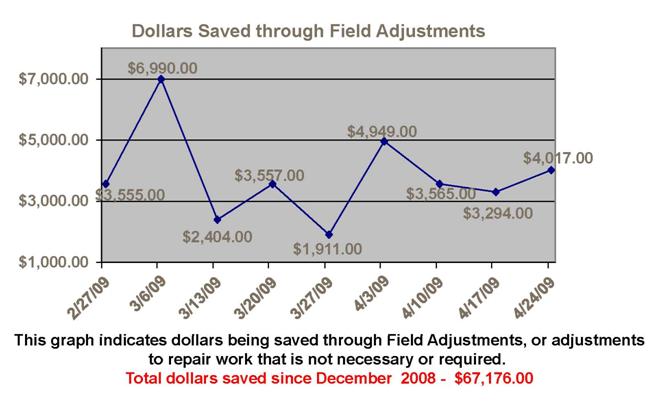
weekly fleet costs. On average, Roger saves over
$3,000 dollars a week on negotiated field
adjustments with the state's supplier community.
This is a major benefit of the OFM ARI Maintenance
Management network.
One
phenomenon OFM frequently sees in this current
economic climate is an increase in suppliers
adding unnecessary costs to the vehicle repair
estimates. We refer to this practice as adding
"gravy" or an extra layer of unnecessary costs
to the quotes. Agencies have to be vigilant to
prevent "gravy" from being added to fleet
estimates. Someone with an expert "fleet eye"
must catch these unnecessary repair costs and
make the supplier renegotiate their original
estimates. This is where Roger Kennedy's unique
talents and abilities play a key cost-saving
role for agencies.
Recently,
Roger was awarded the Department of
Administrative Services (DOAS) Most Valuable
Player award for his continued efforts in
assisting agencies with reducing fleet
expenditures. Below are a few examples of how
Roger is working with OFM customers to reduce
state fleet costs:
·
He saved Kennesaw State precious fleet dollars
on a 2003 Ford Crown Vic Police Unit. The dealer
indicated that a bad engine would have an
estimated cost of $4900 and went to bat as the
DOAS MVP found another engine supplier quoting
$3400. Roger saved the university approximately
$1500.
·
Pineland CSB’s 1997 Ford Explorer needed an
engine and the local shop quoted $4739. Roger
found a source for $3300, saving the agency
almost $1400.
·
Middle Georgia CSB’s 1998 Ford Contour in Dublin
needed an engine. The local vendor quoted $4706
and Roger found an engine for $2570. The savings
were nearly $2500.
Roger's business acumen and experience in
dealing with the state's vendor community has
saved agencies over $67,000 since December 2008!
Roger and OFM are making a difference by saving
precious state vehicle repair dollars. Any
agency interested in taking advantage of this
resource can give Roger a call at 404-656-6295
and watch the savings roll in!
|
|
OFM Changes its
contact Information |
|
By Jim Sever
Effective June 1, 2009, we will be changing our main
contact information for the Office of Fleet
Management. In an effort to streamline our process
for customers to obtain OFM services as well as
reduce our overall expenses, we will change our
contact number to 404-657-6906 and email address to
fms@doas.ga.gov
For your convenience, you can begin using our new
telephone number and email address today as they are
already in place. The new contact information is
currently being used in conjunction with our main
Help Desk number and email address for our VITAL
Fleet Management System. Should you have any
questions, contact Jim Sever at 404-657-6907. |
|
KEY
POINTS IN AUDITING FLEET VEHICLES |
|
Is your agency fleet
safe and cost-effective? Ever wonder what you should
be checking to ensure your fleet vehicles are
operating at their optimal level of performance? The
following Key Points in Fleet Auditing are useful
when compared with your established monthly reports
and documentation:
-
Is your preventive
maintenance being performed in a timely and
efficient manner to ensure vehicles are safe to
operate?
-
Are each of your
fleet vehicles being properly utilized and in
accordance with agency and state policy? Have
you checked your utilization ratio?
-
Are old, turned-in
units being disposed in accordance with state
policy? Do you have any vehicles sitting idle,
needing to be sent to Surplus Property for
disposal?
-
Is your outsourced
fuel provider (e.g., Wright Express) or
maintenance repair supplier providing you with
the services you require, at the agreed-upon
price and at the right level of service?
-
Is someone
reviewing each invoice to ensure suppliers are
not taking advantage of the state? Are you
checking your invoices to ensure non-fleet
expenses are not being charged to the state?
-
Do your monthly
fleet reports in each functional area reflect
the key data needed to properly track the cost
of your fleet?
-
Are your drivers
trained properly to operate a vehicle safely and
are they making cost-effective decisions at the
point of sale (e.g. fuel price shopping,
preventing supplier repair up-selling, etc) to
save your agency budget dollars?
-
Are you reviewing
repair transactions to ensure your agency is not
being charged taxes for services where the state
is exempt?
-
Are assigned
vehicles being monitored to ensure all use is
business related and in compliance with state
and local laws and regulations?
Safe and
efficiently-operated state vehicles enhance agency
productivity, reduce budget costs, and improve
driver morale. Contact the Office of Fleet
Management if you need assistance to effectively
manage your agency fleet vehicles. |
|
|
THE WONDER OF UGA'S REGULARLY SCHEDULED MAINTENANCE
|
|
By Bill Fox, University of Georgia - Fleet
Coordinator
Since 2004, this white van (pictured right) has been
driven to 13 colleges and universities in and around
Atlanta and Athens for 50 weeks per year by one man,
Mr. Theron Sharp. Regular maintenance on this
vehicle has includes: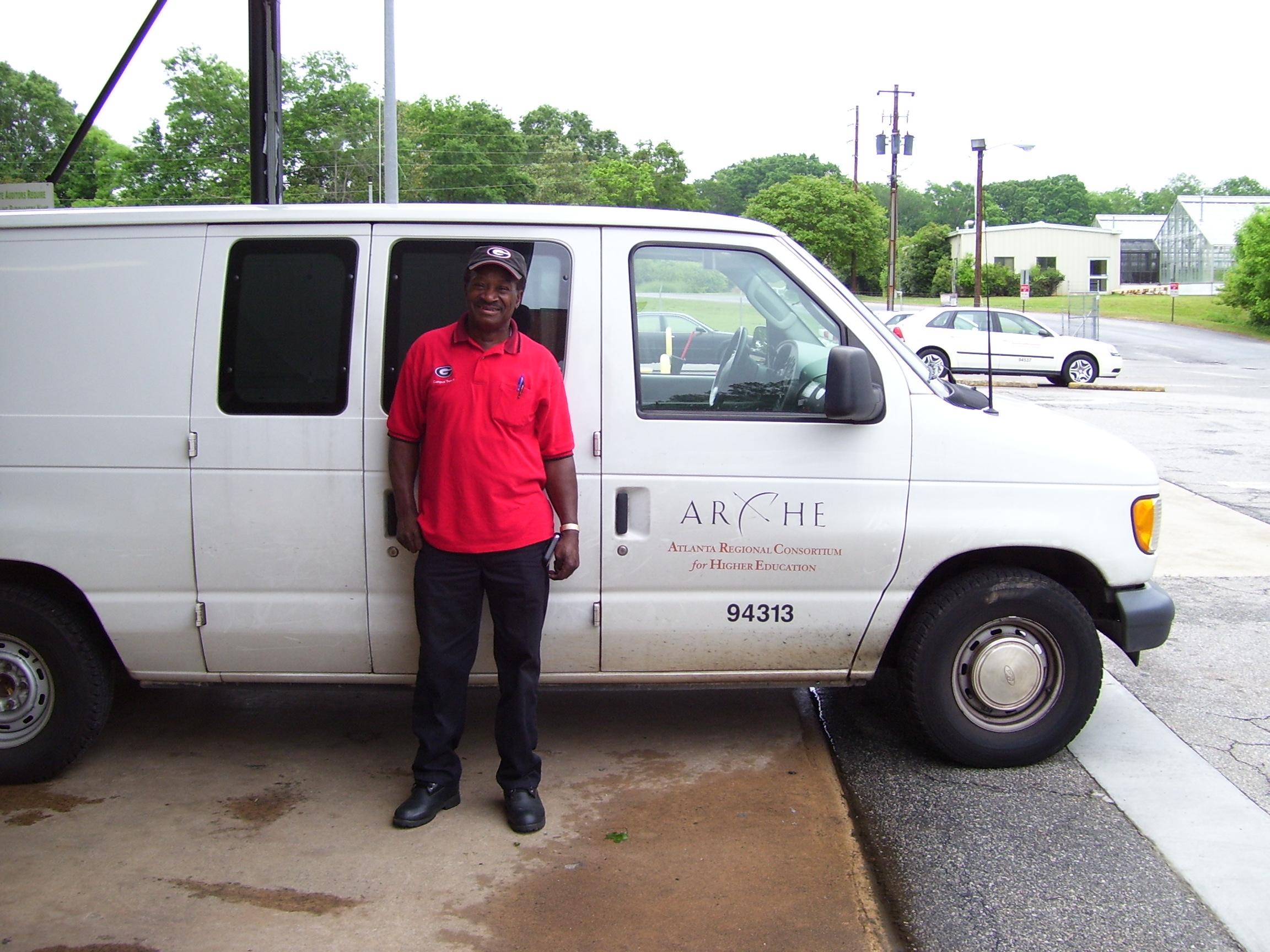
-
Periodic
maintenance on the engine
-
Oil
and filter changes every 3,000 miles
-
Work
on the transmission every 30,000 miles
-
Work
on the radiator every three years
-
A
tune-up every 100,000 miles
-
Brake
flushes every two (2) years.
The only repairs outside of normal maintenance have
been work on the tires, brakes, belts, hoses, and
one alternator replacement. This van has 350,984
miles as of May 4, 2009.
As you can see, the longevity of this van is a
testament to the University of Georgia shop,
preventative maintenance, and the driver's care of
the vehicle.
Happy motoring, UGA! |
|
DOAS Office of Fleet Management
"Driving Change in State Fleet Management!" |
|