|
Mark your
calendars!
GFAC Meeting
March 12th 2009
|
|
|
|
MESSAGE FROM THE DIRECTOR |
|

Greetings!
It has been three months since joining the State of
Georgia Department of Administrative Services (DOAS)
team as the Director of the Office of Fleet
Management (OFM) and my experience thus far has been
wonderful. The State of Georgia has a group of
exceptional people moving in the right direction
trying to save VITAL state fleet dollars.
I’m excited to report that during the past three
months OFM has kicked off some exciting new
initiatives designed to improve the overall
operational performance of the state fleet. First,
OFM began a campaign called, “Mileage is the
Lifeblood of Great Fleet Management!” This campaign
is specifically designed to bring a renewed focus
and awareness to the overall importance of reporting
accurate mileage to better manage the state’s fleet
assets. In addition, OFM held a contest to rename
its fleet management information system to be more
descriptive of what the system actually means to the
state fleet’s success. I was very impressed to see
the creativity around the state fleet community as I
reviewed over 40 great submittals.
We have also created this eNewsletter publication to
increase communication and provide the latest news,
events, initiatives, and happenings around the state
of Georgia fleet community and the industry. As
always, we welcome your suggestions, ideas and
feedback on how we can improve our services.
Happy Reading,
Steve
Steve Saltzgiver
Director - Office of Fleet Management
Department of Administrative Services
steve.saltzgiver@doas.ga.gov |
|
POLICY CORNER
- FEATURED POLICY OF THE MONTH |
|
DOAS Records Repository
The office of Fleet Management is required by
Executive Order to establish and maintain a
centralized record repository. Below is the policy:
DOAS will establish and maintain a centralized
repository containing, in addition to the title,
information on the purchase, assignment, operation,
use, maintenance, service, repair, fueling, and
final disposal of all motor vehicles operated by
organizations covered by this policy memorandum for
use in managing the State's use of motor vehicles.
Where appropriate, these records will be stored and
maintained in electronic format. All state
departments, institutions, boards, bureaus,
agencies, authorities, colleges and universities
shall provide all information required to establish
and maintain such a centralized repository in a
format to be determined by DOAS.
..Read
more>>
|
|
|
ACCURATE MILEAGE IS THE LIFEBLOOD OF GREAT FLEET
MANAGEMENT |
|
By Steve Saltzgiver
 As
a State fleet management professional you know that
accurate mileage is VITAL to managing your fleet
assets successfully. It's no secret that much of
fleet management's success is highly dependent on
determining and understanding key performance
indicators like tracking vehicle cost-per-mile and
miles-per-gallon; monitoring vehicle use; setting
preventive maintenance intervals; predicting repair
frequencies; determining alternative transportation
options and forecasting future replacement needs.
Unfortunately. without accurate mileage these core
fleet functions become next to impossible to manage. As
a State fleet management professional you know that
accurate mileage is VITAL to managing your fleet
assets successfully. It's no secret that much of
fleet management's success is highly dependent on
determining and understanding key performance
indicators like tracking vehicle cost-per-mile and
miles-per-gallon; monitoring vehicle use; setting
preventive maintenance intervals; predicting repair
frequencies; determining alternative transportation
options and forecasting future replacement needs.
Unfortunately. without accurate mileage these core
fleet functions become next to impossible to manage.
In
2009, OFM will be assisting agencies with a renewed
focus on improving the state fleet's overall mileage
accuracy.
Our expert team of analysts will begin using the
fleet system data to inform agencies where existing
mileage problems exist and need updating to bring
each of your fleets back into compliance. In order
for OFM to manage this program efficiently and
effectively we will be focusing on the "Top Ten"
agencies with the most weekly odometer reading
errors. However, if you have a question about where
you fleet operation sits regarding accurate mileage,
please contact Bobby Arrington at
bobby.arrington@doas.ga.gov
It’s hard to believe,
but I have been around the fleet business now for
over thirty years and recognized early in my fleet
career that there is nothing more VITAL to effective
fleet management obtaining accurate mileage. For
those not associated with fleet management on a
daily basis - like those of us in OFM - it may not
be readily apparent why mileage is so critical for
the successful management of a fleet, which is why
OFM has chosen to make this a focus of our state
fleet operation. OFM’s primary objective of the
“Accurate Mileage” campaign is to assist in
educating fleet vehicle users of the VITAL
importance of reporting accurate odometer readings
when they utilize, fuel, and/or repair state
vehicles during the course of carrying out their
Department’s critical missions. The state’s fleet
coordinators need this VITAL information to
provide...
Read
more>>
Tips & Tricks
Correcting your Mileage Errors
By Bobby Arrington
Working with the Wright Express (WEX) Error
Spreadsheet each week can be a daunting and somewhat
overwhelming task; however, if one takes the
approach of just trying to manage the top 10 each
week AND educating our drivers on the importance of
good mileage, the errors will become more
manageable.
Below is a procedure to help you in this process of
correcting errors from the WEX Error Spreadsheet.
-
Take the weekly WEX Error Spreadsheet and use
the filter option to display only your agency’s
WEX Errors.
-
Now, review how many different locations in your
agency have WEX Errors: For example, one may
have 89 locations but only 34 of those had WEX
Errors. (Filter by location)
-
By looking at each location; take note of how
many of those vehicles had multiple errors (Out
of 80 total WEX Errors only 50 different
vehicles were involved)
-
After looking at the total number of WEX Errors
for each vehicle and deleting the ones that have
multiple errors, then the real errors will not
look so bad and become more manageable.
-
Finally, start contacting the locations to
inform them of the errors and for them to make
the adjustments in VITAL for correction.
"Accurate
Mileage is the “Lifeblood” of Great Fleet
Management!"
|
|
VITAL - Great Idea Award |
|
Congratulations Frank
Rodriguez for your VITAL idea!
By Jim Sever
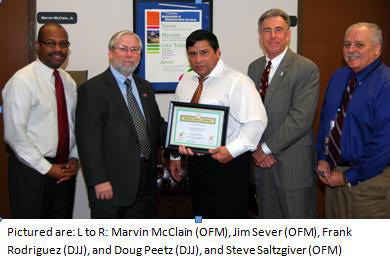
The Office of Fleet
Management (OFM) held a contest for selecting a new
name for our Fleet Management System. After a
complete review of over 40 creative entries
submitted from all over the state OFM selected its
finalist. Mr. Frank Rodriguez of the Department of
Juvenile Justice (DJJ) came up with the winning name
of “VITAL” Vehicle Information Tracking And
Logistics”.
Frank’s VITAL entry
was selected because it epitomizes the message of
the importance relating to effective fleet
management and its VITAL importance of performing
the state VITAL mission. The VITAL name will be used
as part of OFM’s future marketing and management
strategy to aid agencies with understanding the
VITAL importance of effective fleet management and
the critical ongoing operational metrics. For his
winning selection, Frank received a framed
certificate signifying “Great Idea Award” and a $25
gift card to purchase fuel. |
|
DOAS WELCOMES NEW FLEET DIRECTOR |
|
Steven Saltzgiver joined DOAS as Director of the
Fleet Management. A 30-year veteran in Fleet
Management and Public Transportation, Steve most
recently worked with Mercury Associates, one of the
premier fleet management consulting companies in the
country while also serving as Executive Director of
the National Conference of State Fleet
Administrators (NCSFA). Mr. Saltzgiver worked with
numerous states as a consultant on various strategic
fleet management issues, but he also served the
State of Utah for over 12 years as Division
Director, Fleet Operations & Surplus Property
Services. In this capacity, Steve completely
revamped Utah's fleet operations, authoring new
legislation and statutes enabling his team to reduce
division operating budgets...
Read
More>>
|
|
Maintenance Management Program
|
|
OFM’s
Successful Maintenance Management Program
By Steve Saltzgiver
Looking to save fleet
dollars for your agency? One of the primary goals of
the Office of Fleet Management is to provide
effective service offerings, mechanisms and
methodologies for state agencies to manage their
fleet activities relating to state vehicles (e.g.
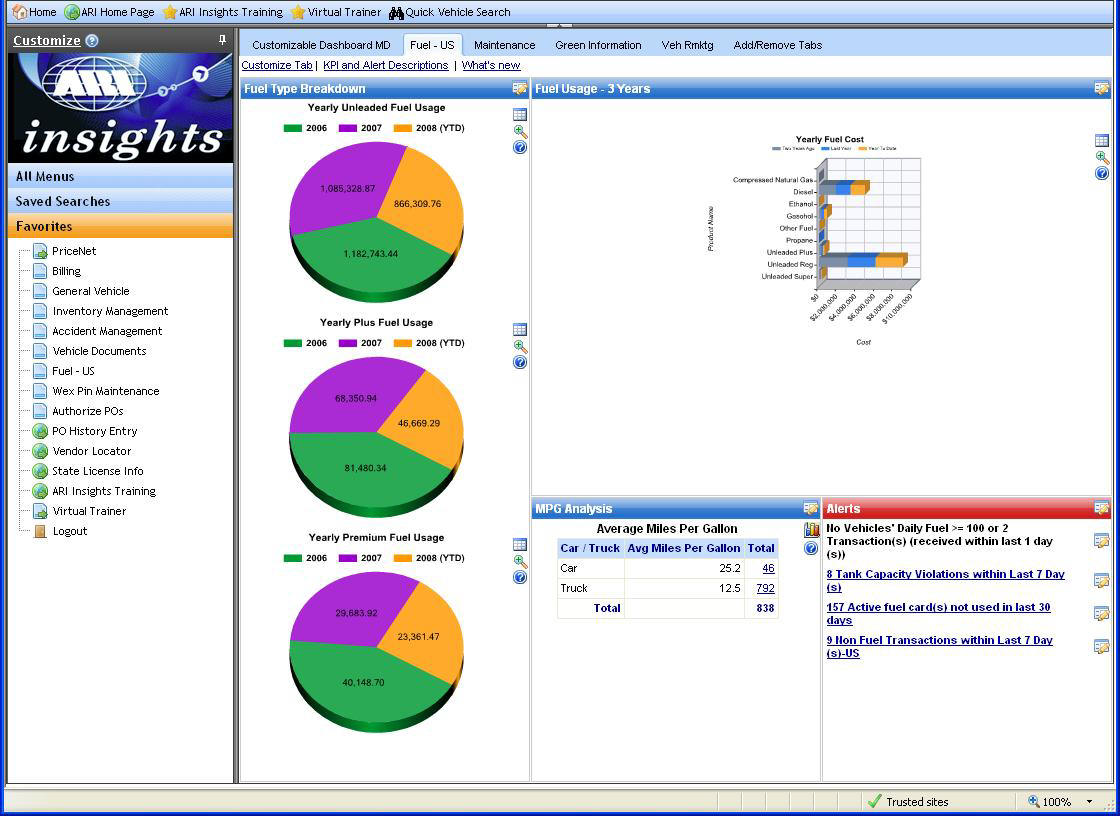
ARI, Wright Express, Enterprise, etc.). Accumulating
accurate data to analyze fleet vehicle costs and
activities is a best fleet management practice and
can successfully lead to the establishment of
reliable metrics and comparable benchmarks to gauge
state agencies against their peers and industry
fleets.
Additionally, better
understanding costs leads to continuous improvements
throughout the state fleet in the form of cost
reductions and increased efficiencies. Back in 1999
the Office of Fleet Management contracted with
Automotive Resources International (ARI), - a world
leader in providing vehicle maintenance management
services – who provides, preauthorized approval
services, expert field adjustments, and ongoing
vehicle repair savings. During the past several
years the state has saved millions of precious tax
dollars - more than paying for the ARI monthly fees
- by reducing other fleet related expenses in the
following areas:
-
Reductions in
Administrative Costs
-
Access to
Nationwide Network of Qualified Vendors
-
Repair Cost
Avoidance
-
Warranty Recovery
-
Real-time Access
to Agency Fleet Data
-
Placing Your
State-owned Repair Shop Facility On ARI
-
Your Bottom Line
Depends on Great Vehicle Management
Reductions in Administrative Costs
Administrative costs associated with
processing literally thousands of invoices and
subsequent payments to pay vendors to compensate
them for their services. Using ARI’s program allows
the state agencies to pay a single invoice...Read
More>> |
|
DID YOU KNOW?
INTERESTING FACTS ABOUT THE STATE FLEET |
|
Ten facts about the state
fleet:
- Fact #1: OFM saves
state agencies over $3,023 dollars a week in
repair cost field adjustments.
- Fact #2: Average
age of the state fleet is 8.4 years.
- Fact #3: Size of
the state fleet is 20,484 vehicles. (CSBs
included)
- Fact #4: State
averages almost 12,000 fuel transactions a week.
- Fact #5: State
spends over $258,000 a week in fuel costs using
the Wright Express fuel card.
- Fact #5: State
fleet purchases over 150,000 gallons a fuel each
week using the Wight Express fuel cards.
- Fact #6: State has
over 1,928 vehicles capable of operating on
alternative fuels.
- Fact #7: State
agencies have vigilantly reduced their weekly
Wright Express mileage errors from 15.33%
(1/2/2009) to 8.83% (2/16/2009) representing a
42% improvement in just 6 weeks.
- Fact #8: About 92%
of state fleet vehicles have Wright Express
cards assigned.
- Fact #9: State
operated 4,567 vehicles assigned to individual
state employees.
-
Fact #10:
State operates 2,720 "overnight" take home
vehicles used by various agencies.
|
|
THE
POWER OF A PENNY |
|
What Much Can a Penny
Save?
Did you know that in
FY08 the state of Georgia
purchased over 11 million
gallons of fuel for the state’s fleet. We are on
track in FY09 to purchase over 12,400,000 gallons of
fuel.
THAT IS A LOT OF
FUEL!!
In this current
economy, we as consumers look for
ways
to conserve and cut back on
our expenses and
stretch our hard earned dollars. Here at the state
of Georgia, we should do
the same. Do you
know that if we were to save just 1 penny per gallon
of gas; what that would save Georgia Taxpayers?
How about over
$124,000 per year! Read
More>> |
|
STRATEGIC INITIATIVES
- MANAGING LOW USE VEHICLES AND HIDDEN COSTS? |
|
Looking for additional savings in your agency fleet?
The single
biggest expense with managing a fleet of vehicles is
depreciation which represents approximately 53% of
the total vehicle costs. This past month the Office
of Fleet Management created a "Top Ten" list of
state agencies with the most vehicles categorized as
low use units based on the following criteria:
-
Units
operating less than 6,000 miles in 2008
-
Units
operating less than 3,000 miles in 2009
-
Units using
less than 350 gallons of fuel in 2008
-
Units using
less than 175 gallons of fuel in 2009
Reviewing your
fleet operation on a regular basis looking for
vehicles that may be removed based on low use is the
best way to find hidden savings in your fleet. How
do you determine low use? The best way to determine
low use if to perform or calculate the "Break-even"
point related to keeping a vehicle in service.
Consider other less costly transportation options
like:
-
Employee Mileage Reimbursement: In
certain circumstances it is much less expensive
to pay an employee mileage reimbursement (i.e.
sedans) at .55 cents per mile than keep a low
use unit in the fleet. Look for these hidden
savings...
-
Short-Term Rentals: It is generally much
less expensive to sell low use vehicles and rent
backup units on an "as needed" basis from a
commercial rental agency (i.e. Enterprise). This
especially works well for standard vehicles that
are readily available, like sedans, SUVs, vans,
and light duty pick up trucks.
-
Pooling
Vehicles: Look for vehicles in agencies
that have commonality and may be placed in a
pool where several others can check out these
vehicles on a "as needed" basis. Pooling
vehicles saves valuable fleet dollars!
As agencies
review their vehicles they should be looking for the
other "hidden costs" of managing a fleet of
vehicles. These hidden costs usually manifest
themselves as "indirect" expenses that may be
in the form of:
-
Parking
Space: Unused vehicles taking up parking
space or valuable real estate. The cost of
parking generally ranges between $5 to $10 per
day. Many institutions like colleges and
university need extra parking space for their
student population. An agency may be able to
sell unused vehicles and lease parking spaces
for additional revenues to offset expenses in
the fleet.
-
Storage
Space Fees: Unused vehicles being stored
costs money. An agency may be money ahead to
sell unused vehicles versus paying storage fees.
-
Insurance Costs: Agencies generally
carry insurance premiums on unused vehicles.
Consider selling unused vehicles recouping both
the sale proceeds and cost avoidance of
cancelling insurance premiums.
-
Data
Management Costs: The ongoing cost of
tracking vehicles in a data repository costs
money if the vehicle is not be utilized.
Consider purging your fleet of unused vehicles
and eliminate the data input, memory and server
space.
-
Parts
Management Costs: If you are operating a
repair shop you may be inventorying several
parts associated with an unused vehicle that are
slowly becoming less valuable and potentially
obsolete. Consider purging your low use vehicles
along with the parts associated with these
units. Double bang for the buck!
There are other
less obvious reasons why some agencies continue to
keep unused vehicles around. These reasons range
from preserving a vehicle allocation if and when the
moratorium is lifted to lack of personnel to get
these units to surplus property.
The
Office of Fleet Management is currently working with
each of the state agencies to develop "Low Use"
codes to effectively identify valid reason for
these type vehicle applications. In the event you
need assistance in better managing your low use
vehicles, please contact us for more information and
assistance. We're here to
assist you with your unique fleet management needs. |
|